Does a Name Tell You Who You Are or Do You Decide What It Means?
- Marcus D. Taylor, MBA

- Feb 5
- 4 min read
Listen to the Blog Article Below:
A close friend and fraternity brother and I once talked about names. Not casually, but deeply. We talked about how a name might tell you who you are, or at least hint at who you are becoming. Many of us carry names without ever asking what they mean. And even when we do ask, do our parents always know the meanings behind the names they give us? Sometimes they do. Sometimes they have a general idea. Sometimes they are drawn to sound, family tradition, or intuition rather than definition.
The conversation eventually shifted from names to destiny.
That question stayed with me longer than I expected.
What are you when it comes to destiny?
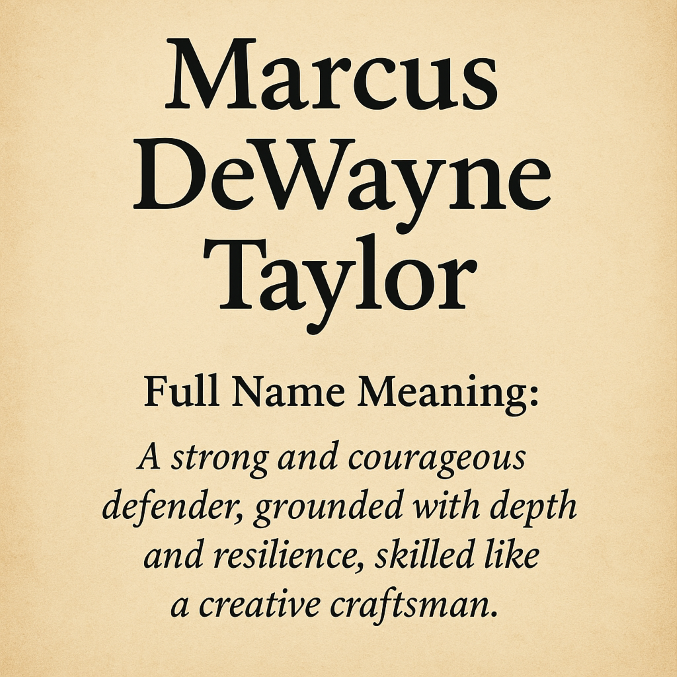
Out of curiosity, not because I felt incomplete or was looking for validation, I looked up my full name. First. Middle. Last. I used historical and linguistic sources and let the definitions speak before forming conclusions.
What I found made me pause.
My first name, Marcus, is Latin in origin. Traditionally understood as “dedicated to Mars,” the Roman god of war, it carries associations of defense, leadership, and responsibility under pressure. In ancient Rome, the name was commonly associated with nobles, soldiers, and statesmen. One of the most well-known bearers is Marcus Aurelius, a leader shaped by war who emphasized discipline, restraint, and moral responsibility in both action and thought.
What mattered to me was not symbolism for symbolism’s sake. It was alignment.
I am a 23-year military veteran. I have served in combat. I have trained in disciplined fighting systems. I played football for years, a structured and regulated form of conflict that demands teamwork, accountability, and controlled force. None of this was about chaos. It was about responsibility under pressure.
Then there is my middle name.
My mother spelled it DeWayne, with a capital “W,” intentionally. That letter mattered. She explained that the “W” was symbolic, shaped like a lion’s mane or a protective hood. Not decoration. Not flair. Protection.
That framing stayed with me.
Historically, the name traces back to Irish and Gaelic roots, often associated with a wagon maker or craftsman. Someone who builds. Someone who works with their hands. Someone who is dependable and grounded. Not removed from labor. Not afraid of work.
The capital “W” adds another layer. A covering. A shield. Something that protects what matters without announcing itself. Strength that does not posture. Presence without noise.
That symbolism aligns far more with how I move through life than I ever expected. Calm. Direct. Steady. Protective of people, space, and purpose. Not reactive. Not theatrical.
Then there is my last name.
Taylor comes from Old French and Middle English, referring to someone who cuts cloth. A trade centered on precision, refinement, and fit. A tailor does not simply cut. A tailor measures. Adjusts. Removes excess. Shapes something so it serves its purpose well.
That part stopped me.
My professional work lives in design. Instructional design. Graphic design. Systems design. AI-supported learning environments. The work is about structure, clarity, and usefulness. Making information fit people, not forcing people to fit information. Cutting away what does not serve so what remains functions better.
Taken together, the name forms a picture I was not trying to construct.
Marcus DeWayne Taylor can be understood as a defender shaped by conflict, grounded through discipline, protected by purpose, and skilled in thoughtful craftsmanship. Strength paired with restraint. Action guided by intention.
Here is the critical distinction.
I am not claiming my name dictated my life. I am not suggesting destiny is hidden in spelling or syllables. Names do not produce character. Titles do not create integrity. Plenty of people carry strong names and live without discipline. Plenty of people carry simple names and live with remarkable responsibility.
What names can do is reveal themes.
But themes only matter when they are lived.
Who I am is not defined by my name. It is defined by what I choose to practice. By who I learn from. By the standards I accept. By how I respond when pressure is applied. By what I protect and what I refuse to become careless with.
The danger is not believing a name has meaning.The danger is believing meaning removes responsibility.
A name does not excuse behavior. It does not replace accountability. It does not entitle anyone to purpose without effort. At best, it offers a mirror.
What you do after seeing the reflection is on you.
So the real question is not whether your name fits you.
The real question is this.
Who are you allowing yourself to become?
Are you being shaped intentionally by values, discipline, and honest influence, or are you allowing yourself to be shaped by convenience, noise, and reaction? Are you protecting what matters, or simply reacting to what is loud?
In my case, the alignment was not forced. It revealed itself gradually. Not as prophecy, but as pattern.
And patterns only matter when you recognize them and choose what to do next.
Reflection Questions
Have you ever explored the meaning or intention behind your name? What stood out?
What elements of your character were shaped intentionally, and what were shaped by circumstance?
Who or what has served as your protective “hood,” guiding your decisions and boundaries?
If someone observed your life without hearing your titles, what themes would they describe?
What responsibilities are you actively protecting, and which ones are you neglecting?
Identity is not inherited.
It is practiced.


Excellent Article !!!