We Are Small, But Our Choices Are Not

Updated: Mar 3
Listen to the Blog Article Below:
There are nearly eight billion people on Earth. When I let that number sit long enough, it does something to the ego. Not outwardly. Not in action. But inwardly.
Who am I, really?
One of billions on a small planet orbiting a single star. That star is ordinary. Our galaxy is not rare. The universe does not pause for us. In the grand scope of things, we are far smaller than we like to admit. Cosmically speaking, we are closer to ants arguing over ant hills than rulers of anything lasting.
And yet, within that smallness, humans assign themselves enormous importance.
We turn opinions into identities. Disagreements into moral wars. Differences into division. Entire groups rotate between victim and aggressor depending on which role offers leverage at the moment. Responsibility is demanded outwardly but rarely practiced inwardly. Truth bends under optics. Intent replaces outcome. Appearance substitutes for honesty.
Everything starts to feel staged.
What people say often does not align with what they do. Actions are dressed just enough to appear justified. Over time, this behavior becomes structural. Groups form inside groups. Subgroups fracture unity. Inner circles protect themselves. Dissent is punished rather than examined. Organizations decay without ever being attacked from the outside.
You see it everywhere.
School boards.
Military units.
Political parties.
Fraternities.
Sororities.
Corporations.
Even families.
It always begins the same way.
Humans do not need external enemies to self-destruct. We carry the mechanism internally. Ambition without humility. Identity without accountability. Belonging without responsibility.
I did not learn this from theory. I learned it through experience. I saw it clearly in the Army.
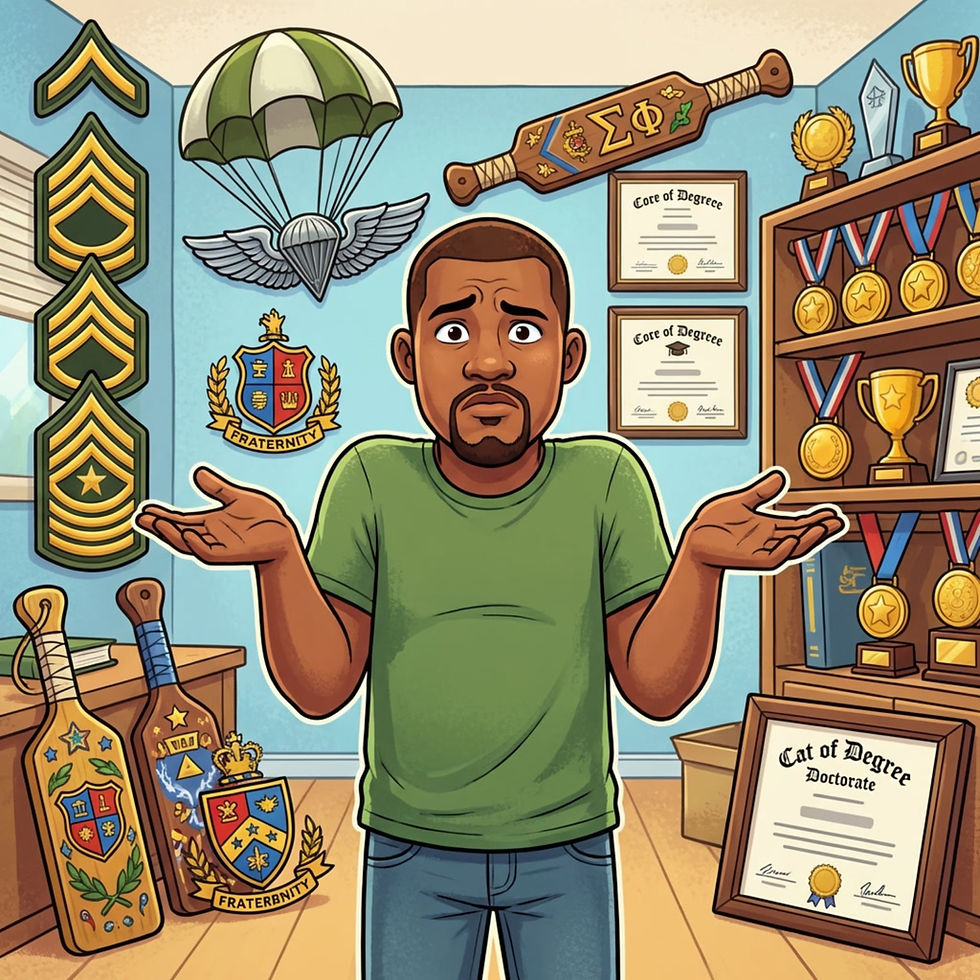
When I enlisted, my understanding was simple and naive. I believed everyone in the military did the same thing. Pick up a rucksack. Run. Train. Fight if called. I did not understand that the military is made up of different professions, responsibilities, and skill sets. In my mind, a soldier was a soldier.
I scored a 112 GT on the ASVAB. I had no idea what that meant. I was told I could do anything in the Army. I was offered a bonus for MOS 92A10, Automated Logistics Specialist. The title meant nothing to me. Even after it was explained, the role still felt abstract. I accepted because it sounded legitimate and because I believed I would still be doing Army things no matter the job.
This was after 9/11. War was no longer abstract. I knew we were already in one. I was willing to serve, but I did not romanticize combat. Those two truths existed together without tension.
Training came naturally. I learned fast. I was strong, athletic, disciplined. I lived in the weight room. I was bigger than most people around me, including some drill sergeants. That changed how I was handled. Less physical intimidation, more pressure over small details. Constant correction. Quiet stress layered over expectation. I did not complain. I grew up with a work ethic rooted in endurance. You did the work and moved on.
When I reached my unit, much of my early career placed me in combat-arms-adjacent environments. Infrastructure units. Mechanized settings. Motor pools. Everyone had a role. Everyone mattered operationally.
But culture rarely follows logic.
I was not considered cool.
I carried an M16A2 with iron sights. No optics. No ACOG. No accessories. Others carried M4s with gear that looked elite. The difference was not effectiveness. It was image.
When we deployed, language sharpened that divide. Labels like POG and FOBBIT quietly communicated that some contributions mattered less simply because they were farther from direct combat.
So I did what many people do. I chased acceptance.
I changed my MOS and joined the infantry.
The bond was real. Tighter. Louder. Discipline increased. Recklessness did too. We got into trouble more. Covered for each other more. Loyalty often ran deeper than accountability.
I performed well. I became a machine gunner. On convoys, I served as a gunner on top of gun trucks. That role carried weight.
But the ladder never stopped.
If you were not airborne, you were not really infantry.
If you were not air assault, you were not elite.
If you were not Ranger, people asked why.
If not 75th, then not truly elite.
If not Special Forces, then not good enough.
If not Delta, then what were you really.
The groups grew smaller. The standards rose. The skills sharpened. That progression made sense.
What did not make sense was the shift in attitude.
Those who were not at the top were not simply different. They were quietly diminished. Not because they failed. Not because they lacked discipline. But because they were not that.
That was when I realized this was no longer about performance. It was about identity. About validation.
Once I noticed it there, I could not unsee it.
In workplaces.
If you do not have this certification, you are dismissed.
If you do not have this degree, you are limited.
If you do not have a master’s, your voice carries less weight.
If you do not have a PhD, sit quietly.
In organizations.
If you are not known by the right people, vouched for by the right group, accepted by the inner circle, your competence rarely matters.
In families.
One branch earns more.
One branch holds degrees.
One branch gains visibility.
And quietly, they look down on those who did not take the same path.
Not everyone is meant to be Delta Force.
Not everyone is meant to be a physicist.
Not everyone is meant to sit at the top of elite institutions.
That does not make them lesser humans.
Every tier exists because every role is necessary. The problem is not excellence. The problem is when excellence mutates into superiority, when skill hierarchy becomes human hierarchy.
Humans naturally want to improve and test limits. That instinct is not destructive by itself. What damages us is confusing what we do with who we are.
We stop respecting roles and start ranking people. We stop valuing contribution and start chasing status. We seek validation upward while dismissing those below.
This is the splinter cell.
This is the descent.
This is how organizations collapse quietly.
This is how families fracture.
This is how societies decay while believing they are progressing.
Purpose-Based Belonging
Over time, I recognized something important about myself.
I have always been part of groups.
That was never the issue.
The difference was why those groups existed and what they demanded from the people inside them.
I consistently aligned with groups that were grounded in mission, vision, and objective rather than ego. In football, it was about execution, discipline, and shared responsibility aimed toward championships, not individual praise. In school, it was about growth and development earned through consistency.
In the military, that distinction became unmistakable.
Orders mattered. Standards mattered. Values mattered. The Army Values, the Noncommissioned Officer Creed, the Soldier’s Creed, and the Warrior Ethos were not about status or self-expression. They were about accountability and service to something larger than the individual.
Those frameworks disciplined behavior. They did not elevate personalities.
In my professional life, the focus was competence strong enough to create opportunity. In fraternal life, the purpose was not social validation but becoming a better man in service of building better men, encouraging younger and newer individuals to pursue excellence and responsibility.
That distinction mattered.
I was never drawn to groups built primarily on popularity or surface-level acceptance. That was not my lane then, and it is not my lane now. My alignment has always leaned toward purpose over performance, standards over symbolism, substance over appearance.
The same applies in business.
The aim is growth in service of the mission, building something ethical, durable, and effective for partners and stakeholders. When work is grounded in purpose, hierarchy becomes functional rather than defining.
Some groups exist to elevate individuals.
Others exist to advance a mission.
Learning to recognize the difference changed everything for me.
Where It Settled
My Army story did not end in elite units or special operations tabs. It ended somewhere quieter.
I became an instructor.
I taught logistics and Quartermaster common core competencies. The fundamentals. The systems most people overlook but depend on every day. That role became the most rewarding work I did in uniform.
Not because it looked impressive.
Not because it carried prestige.
But because it mattered.
Even there, hierarchy appeared again.
I was not only an instructor. I became a basic instructor. Then a senior instructor. Then a master instructor. Once again, tiers. Once again, levels.
This time, I was aware.
I pursued master instructor not to stand above others, but to test myself. To sharpen my skill. To see how much responsibility I could carry. I made a deliberate choice not to weaponize that position.
I helped those below me reach their level without judgment.
I did not treat beginners as lesser.
I did not dismiss those who had no desire to advance.
I did not confuse instructional rank with human worth.
Some wanted to teach a few classes well.
Some wanted mastery.
Some needed competence and nothing more.
All of it was valid.
That was when the lesson settled fully.
Hierarchy is unavoidable.
Superiority is optional.
Systems require levels. People do not require humiliation. Excellence does not demand contempt. Mastery does not entitle anyone to look down.
The irony is this. The moment I stopped trying to be seen as elite was the moment my work had the greatest impact.
So I return to the original question.
Who are we?
Not our titles.
Not our ranks.
Not our certifications.
Not our proximity to power.
We are contributors living within finite time, responsible for how we treat others inside the systems we inhabit.
The wrong view of the world says we must climb endlessly and validate ourselves by standing above others.
The better view recognizes that while we hold different roles, we all deserve dignity within them.
When we forget that, we splinter.
When we remember it, we stabilize.
In a universe where nothing we build lasts forever, that discipline may be the most meaningful thing we practice.


Very insightful and reflective. It shows the complexities of people and how those complexities affect those who they come into contact with (whether in a minor or major way).