Association, Membership, and Bonding: Three Models of Connection (And Why We Confuse Them)

Listen to the Blog Article Below:
We gather in organizations, groups, and communities expecting one thing and getting another. Someone joins a fraternity thinking the dues buy access to brotherhood. Someone attends a community event expecting to belong. Someone volunteers expecting camaraderie and finds only transaction. The friction isn't always the organization's fault. Often, it's a mismatch between three distinct relational models that we treat as if they're the same thing.
They're not.
Three Models, Three Currencies
Understanding the difference between association, membership, and bonding isn't semantic. It's the clarity that separates authenticity from disappointment.
Association: Proximity Without Obligation
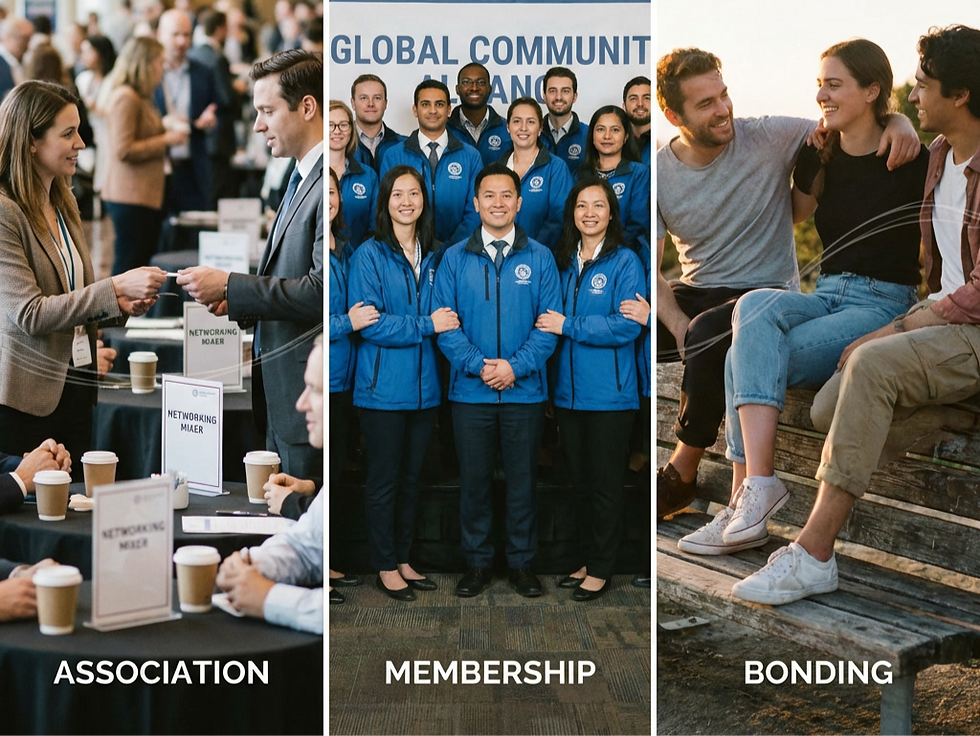
Association is the lightest form of connection. It's showing up. It's proximity. It's a shared space or shared interest that creates a temporary tie.
What defines association:
No gatekeeping. You don't apply or pay to be near people.
No mutual expectation. Being in the same room doesn't obligate you to anything.
Low friction entry and exit. You show up when it works. You stop coming and no one tracks you down.
Surface-level texture. You know people's names, maybe their stories, but not their vulnerabilities.
Examples: attending a community festival, sitting at a networking event, following an online group, showing up to a class.
The honest truth about association: it feels good in the moment, but it's fragile. It dissolves the moment you stop showing up. There's no mechanism to deepen it because there's nothing binding you to anyone else.
Membership: Formal Commitment With Mutual Expectations
Membership is transactional in structure but not necessarily in spirit. It says: I'm putting something in, and I expect something back.
What defines membership:
Explicit entry criteria. You apply, pay, agree to terms, or meet conditions.
Mutual obligations. The organization commits to serving you. You commit to following its rules or participating in its functions.
Skin in the game. You've invested something (money, time, reputation) that makes leaving costly.
Accountability structures. There are consequences for violating the covenant.
Examples: paying fraternity dues, joining a gym, subscribing to a service, becoming a professional association member, attending a course with enrollment.
The honest truth about membership: it gets a bad reputation because we call it "transactional" like that's a flaw. But transaction isn't shallow. A transaction is a promise with teeth. When you pay dues, you're saying: "I value this enough to commit." The organization is saying: "We'll honor that commitment by maintaining standards." That's not less authentic than association. It's differently authentic. It's honest about what you're getting.
Bonding: Relational Depth Through Shared Experience and Vulnerability
Bonding is the deepest form of connection. It's what people actually want when they confuse it with the other two.
What defines bonding:
Earned over time. You can't rush it. You can't buy it. You build it through repeated interaction, shared challenge, or mutual vulnerability.
Reciprocal risk. Both people are invested and exposed. Neither one is safe to be indifferent.
Tested through friction. Real bonds survive disagreement, misunderstanding, or competing needs. They grow stronger because of it.
Voluntary depth. You choose to reveal yourself, and the other person chooses to honor that revelation.
Examples: close friendships, mentor relationships, brothers-in-arms from shared struggle, Kappa League mentors and mentees after years of showing up.
The honest truth about bonding: it's not a transaction. It's not transactional because it can't be contracted. You can't write a membership agreement that guarantees bonding. You can only create conditions that make it possible—and then do the hard relational work of showing up, being vulnerable, and letting someone matter to you.
The Confusion: When Models Collapse Into Each Other
Here's where the authenticity question becomes critical. Most organizational disappointment happens when we expect one model but the organization delivers another—or when we pretend a lighter model is heavier than it actually is.
Scenario 1: Association presented as Bonding
A young professional joins a networking group expecting to find "their people." The group is actually just association—pleasant proximity, surface conversation, no real commitment. When deep friendship doesn't materialize, she feels betrayed. The group never promised bonding. It offered association. The mismatch is real, and it's painful.
What's the organization's responsibility here? To be honest about what it is. If it's association, say so. "We gather to meet professionals in your field. You'll make contacts and learn industry trends. Some people find deep friendships here; most find acquaintances and move on."
Scenario 2: Membership confused with Bonding
A man joins a fraternity, pays his dues, shows up to meetings and events. He assumes the dues and attendance automatically create brotherhood. He expects people to defend him, cover for him, prioritize him. When they don't, he feels the organization is fake.
What's the mismatch? Membership is structural. Bonding is relational. The dues bought him access to the organization and its standards. The bonding had to be earned through vulnerability, consistent presence, and willingness to invest in other people's growth. You can have membership without bonding (and plenty of fraternities do). The organization's job is to clarify this.
"Your dues sustain us. But your brotherhood? That's built by how you show up for your brothers."
Scenario 3: Bonding demanded without Membership structure
A community group operates on pure association—no dues, no structure, no accountability. Over time, a few people develop real bonds. But because there's no membership structure, when someone doesn't show up, no one knows if they've quit, moved, or just forgot. The bonded people feel abandoned by the group's lack of care. The group feels like bonding should fix everything the structure fails to do.
The truth? Bonding can't replace structure. You need membership clarity (who's in, what we expect, what we offer) so that bonding can actually grow. Without it, bonding becomes too fragile and too reliant on individual goodwill.
What's Actually Authentic?
This is where critical thinking matters more than judgment.
Authenticity isn't about which model is "best." Authenticity is about alignment between what's offered and what's real.
An organization is authentic when:
It's clear about its model. "We're a networking association for professionals. Come meet people. No obligation. No dues. You stay as long as it serves you." That's honest. That's authentic. That's not less valuable because it's lighter.
It doesn't pretend a transaction is a relationship. "Your membership dues support our operations. In return, you get access to our facilities, events, and governance processes. Friendships may develop, but they're not guaranteed by your fee." That's transactional framing, but it's not dishonest. It creates space for both transaction and genuine connection.
It builds structure that makes bonding possible, not guarantees it. "We're organized around shared values. We have standards. We expect consistency. Within that container, real friendships are built by people who choose to be vulnerable with each other." This is how strong organizations work. Structure creates safety. Safety allows bonding.
It honors what it actually is. A gym is a gym. It's not a community unless people make it one. A professional association is an access platform. It's not a brotherhood unless members invest in each other. An online group is association. It's not a movement unless it has structure, accountability, and relational depth.
Why This Matters: The Design Question
When you're evaluating an organization—or building one—ask yourself:
What model are we actually offering?
If it's association, that's fine. Own it. Make it inviting, low-friction, and honest about its limits.
If it's membership, that's fine too. Structure it. Create clear expectations. Make the transaction transparent. Let the accountability build trust.
If you want bonding, understand that bonding can't be mandated. It emerges from structure, vulnerability, and time. You can create conditions for it (stable membership, shared mission, regular deep interaction). You can't force it.
The most authentic organizations often have all three layers:
Association layer: Inviting to people exploring, no barrier to trying.
Membership layer: For people ready to commit, clear terms, mutual accountability.
Bonding layer: For people who invest in relationships, structures for vulnerability and shared challenge (mentorship, small groups, service projects).
This isn't about being all things to all people. It's about being honest about what each layer offers and letting people choose where they belong.
The Personal Question
Here's what I think I am really asking: Do people understand what they're choosing? And are they okay with what they actually get?
Some people want association. They want the flexibility to show up or not. They want community without commitment. That's valid. Honor it.
Some people want membership. They want to buy clarity. They want structure and accountability. They want to know that if they commit, others will too. That's valid. Honor it.
Some people want bonding. They something deeper.
Authenticity, then, isn't about which model is "real." It's about this: knowing what you're getting, choosing it consciously, and building relationships that match the promise you've made to each other.
Everything else is just confusion dressed up as complexity.



Great perspective. Too many people expect bonding without investing the time and consistency it takes to build it. Association, membership, and bonding all have value; clarity about which one you’re in makes all the difference.