What Happened to the Comment Section?

Updated: Jan 21
Listen to the Blog Article Below:
There was a time when the comment section functioned as a public commons. It was imperfect, loud, and sometimes messy, but it served a purpose. People tested ideas there. They questioned assumptions. They disagreed openly. Occasionally someone trolled, yet even that friction revealed something about the culture and the confidence of individual thought.
Today, that space has changed. What once reflected a range of perspectives has narrowed into echo chambers where agreement is rewarded, dissent is punished, and silence often feels like the safest option.
From Individual Thought to Group Validation
Early comment culture valued response over reaction. Someone shared an idea, others challenged it, and the exchange sharpened understanding on both sides. The goal was not applause. It was expression.
Now, many comment sections operate as validation loops. Visibility comes from alignment, not insight. Comments rise because they confirm what a group already believes, not because they add clarity or depth.
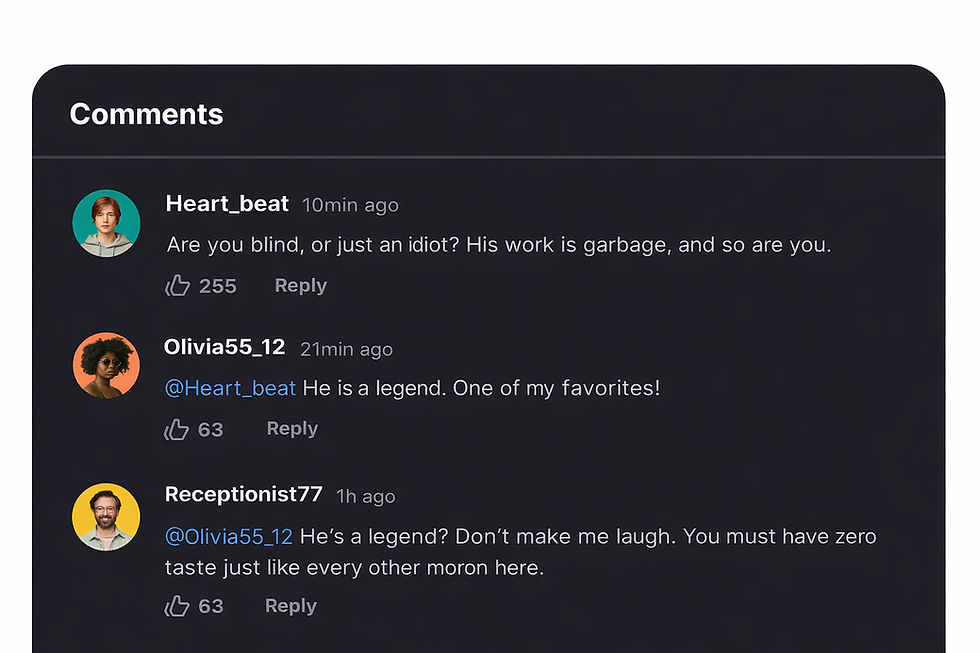
Disagreement no longer invites discussion. It invites pile ons. Not conversation, but enforcement.
Over time, this discourages independent reasoning. When people learn that thinking independently leads to ridicule or reputational harm, they adjust. Some retreat into silence. Others harden into extremes. Thought shifts from curiosity to defense.
What Healthy Disagreement Actually Looks Like
Disagreement itself is not the problem. A culture without disagreement stagnates. What has been lost is the discipline that once separated thoughtful opposition from public domination.
Healthy disagreement challenges ideas without attacking identity. It corrects without humiliating. It introduces friction without turning conversation into combat.
Disagreement asks whether an idea is sound.
Domination asks how to win the exchange.
Correction seeks clarity.
Humiliation seeks control.
When disagreement is guided by intent and restraint, it sharpens thought. When driven by ego, it ends dialogue.
Echo Chambers as Cultural Norms
Echo chambers do not form by accident. Platforms reward engagement without weighing substance or intent. Emotion spreads faster than nuance. Certainty travels farther than questions.
Culture mirrors this pattern. In music, media, and public discourse, insiders and outsiders are increasingly defined by ideological alignment rather than thoughtful distinction. The song They Not Like Us by Kendrick Lamar resonated not only as competition, but as a cultural signal of separation and isolation.
That posture now defines many comment sections. They function less as spaces for exchange and more as markers of loyalty.
Engineered Outrage and Platform Incentives
This shift is not driven by individuals alone. Digital platforms are designed to reward reaction rather than reflection.
Algorithms elevate what provokes response. Anger keeps people engaged. Certainty attracts affirmation. Group alignment increases visibility. Nuance disappears quietly.
Comment sections are shaped environments, not neutral spaces. Speed is rewarded. Emotion is amplified. Loyalty is visible.
Personal responsibility still matters. But environment influences behavior. Ignoring that reality oversimplifies the problem.
Cancellation by Comment
One of the most destructive evolutions of comment culture is its use as a weapon. People now attempt to cancel businesses and individuals through comments alone. Often without firsthand experience. Without verification. Without accountability.
A negative comment no longer represents experience. It represents allegiance.
False reviews and coordinated pile ons damage livelihoods. The crowd becomes judge and executioner, then moves on. This is not accountability. It is social punishment without evidence.
Critics, Narratives, and Narrowed Thought
This pattern extends into film and media commentary. Projects are praised or condemned based on ideological alignment rather than storytelling, craft, or execution.
Audiences lose trust. Creators avoid risk. Art contracts because complexity invites conflict.
When commentary prioritizes moral signaling over honest evaluation, free thought shrinks. Spaces meant to challenge assumptions reinforce them instead.
Entitlement Without Discernment
An underlying cause of this shift is a growing belief that expression requires no discipline. The assumption seems to be that every thought deserves public expression simply because it exists.
Older filters have been discarded.
Should every thought be expressed
Would this benefit anyone besides me
Do I know enough to make a meaningful statement
Will this add clarity or distract from the original point
These questions once guided public speech. Now they are often ignored.
Many comments are not responses to ideas. They are emotional reactions seeking dominance. Instead of engaging the original argument, the space is hijacked and redirected toward validation.
I feel something, therefore I must speak.
I disagree, therefore I must dominate.
I am uncomfortable, therefore the idea must be challenged publicly.
Expression becomes entitlement. Responsibility disappears.
Fear Beneath the Arrogance
Much of what appears as arrogance in comment sections is driven by fear.
Fear of being wrong publicly.
Fear of losing social standing.
Fear of being excluded.
Correction feels like exposure. Context feels like threat.
Rather than process discomfort privately, many assert dominance publicly. Once identity is being defended instead of ideas, learning stops.
Private Thought Versus Public Contribution
Not every thought requires a public outlet.
There is a difference between internal reflection and public contribution. Maturity is knowing when to speak and when to process privately.
Public speech carries responsibility. Once expressed, a thought redirects conversation and shapes others.
Discernment asks whether a response adds clarity or interference. When that discipline disappears, conversation collapses into noise.
A Case Study in Correction and Deflection
I recently saw a Facebook post repeating a common quote: “Money is the root of all evil.”
I offered a simple correction. The Bible states that the love of money is the root of all kinds of evil. Money itself is neutral. Idolatry is the issue. When money is cherished above principle, purpose, or people, judgment can be corrupted.
That clarification was not received as dialogue. It was met with defensiveness and ridicule.
Who are you, the social media Bible verse corrector?
No public shaming occurred. Yet embarrassment was perceived. Context was treated as threat. Another voice joined in to defend belief rather than examine it.
At that point, the conversation had shifted. Learning was no longer welcome. Disengagement became the only rational choice.
When Correction Feels Like Threat
This is now common. Correction is interpreted as insult. Clarification is framed as dominance. Context is reduced to condescension.
What disappears is discernment.
Am I reacting because the idea is flawed or because I feel exposed
Am I engaging thought or protecting identity
Without these questions, discourse cannot evolve.
A Necessary Counterpoint
Some argue that comment sections give voice to those historically excluded. That deserves acknowledgment.
But lack of voice does not justify lack of discipline.
Expression without care recreates chaos, not inclusion. Access to speech carries responsibility to use it well.
The Responsibility We Avoid
The comment section did not collapse because people stopped caring. It collapsed because caring lost discipline.
Before commenting, responsibility requires pause.
Am I responding to the idea or my emotion
Am I adding clarity or redirecting attention
Am I correcting to serve understanding or asserting control
Silence is not weakness. Restraint is not censorship. Discernment is maturity.
The comment section once revealed how people think. Now it often reveals how people perform.
Whether it becomes a space for thought again depends less on platforms and more on individuals choosing responsibility over reaction.
Thoughtful disagreement still matters.
But only when guided by discernment rather than entitlement.



Comments